
Why Dinosaurs Still Hold Us Captive

A World That Is Ours, Yet Not Meant for Us
Imagine walking through a prehistoric forest. At first, it does not seem completely alien. The ground beneath your feet is soft, covered not by grass but by a thick layer of damp ferns. Fallen cycads twist their roots across your path, forcing you to watch every step. The air feels heavier than what you know, warm, humid, and dense enough to make every breath noticeable. Sunlight struggles to reach the forest floor because giant tree ferns and ancient conifers rise above you, blocking much of the sky. Around you, insects buzz loudly, and somewhere deeper in the forest, there are calls you cannot identify, sounds that belong to no world you have ever experienced.
Then you reach an opening. Below you stretches a wide valley, green and endless, and suddenly a head the size of a car rises above the trees. It lifts slowly from a neck so long your eyes need a second to follow where it ends. Huge nostrils flare as the animal notices you, pauses, then calmly turns away and tears leaves from a branch high above the ground. Beyond it, more enormous bodies move through the valley, some carrying horns, some covered in armor, some dragging tails across the earth, some moving in groups.

And in that moment, the reason dinosaurs grip us becomes obvious: this is our planet, but it is a version of Earth where we would not belong for long.
That tension never leaves us. Dinosaurs lived under skies that were once just as real as ours, on continents that later became the world we know, yet everything about them feels distant enough to seem almost fictional. They are not invented creatures, yet they often feel less believable than dragons because they truly existed.
The First Time Humans Imagined Themselves as Small
Part of dinosaur fascination comes from something deeply psychological. We are used to living in a world shaped around human dominance. Even when nature is dangerous, we face it through roads, buildings, medicine, machines, and systems that give us control. Dinosaurs belong to a chapter of Earth where none of that matters.
In the Mesozoic world, a human being would have no natural advantage. Without technology, shelter, tools, or numbers, we would be physically insignificant. A giant predator would not see us as powerful. A plant-eater large enough to shake the ground could kill us without noticing we were there. That idea unsettles us because it removes us from the center of the story.
Children feel this immediately. Adults understand it more consciously, but the reaction is similar: awe mixed with discomfort. Dinosaurs force us to imagine a world where humans are not important, not dominant, not even relevant.
For children, this often becomes their first real encounter with deep time. A thousand years is difficult enough to imagine, but dinosaurs introduce millions of years, vanished oceans, shifting continents, and lost ecosystems. For adults, that same scale creates perspective. Dinosaurs remind us that human history occupies only a tiny fraction of Earth’s story.
Why Dinosaurs, More Than Any Other Extinct Animal?
Many species are extinct, yet few hold the human imagination the way dinosaurs do. We do not build endless films around giant ground sloths, ancient crocodiles, or prehistoric deer. Dinosaurs became something larger because they combine extremes in a way no other extinct group does.
They were enormous. Many were heavily armed. Some were fast, some strange, some almost absurd in shape. They ruled land, air, and seas through different branches of prehistoric life. Their skeletons look dramatic even before you understand what they are. A child seeing a dinosaur skull for the first time does not need a scientific explanation to understand that this was something extraordinary. But size alone is not enough. Dinosaurs also carry mystery because no human has ever seen one alive.
Every dinosaur image we know is built from fragments: a tooth, a claw, a vertebra, a footprint, a nest, a skull. Scientists reconstruct animals no one has ever witnessed, and that leaves space for imagination in a way few scientific subjects allow. A fossil suggests movement. Bone shape suggests muscle. A nest suggests parenting. A footprint suggests speed. That means dinosaurs remain both real and unfinished.
A species once imagined as reptilian is later shown to have feathers. A dinosaur thought slow becomes active and agile. A predator once drawn roaring like a lion may have sounded closer to birds, crocodiles, or something unlike anything alive today. This constant revision keeps dinosaurs alive in the public imagination because they never feel fully settled.
The Shadow of Extinction
One of the points that fascinates us most is not simply that dinosaurs ruled the Earth, but that they lost it.
For over 160 million years, dinosaurs were the dominant life forms on land. That is an almost unimaginable length of time, far beyond the entire history of human civilization. They were not temporary rulers of the planet. They were successful beyond anything humanity has yet achieved. And then, in geological terms, everything changed suddenly.
An asteroid impact, followed by catastrophic environmental collapse, ended the age of giant dinosaurs and reshaped life on Earth. That story speaks directly to modern human anxiety because it raises an uncomfortable question: if a dominant world can disappear that quickly, what does that say about us?
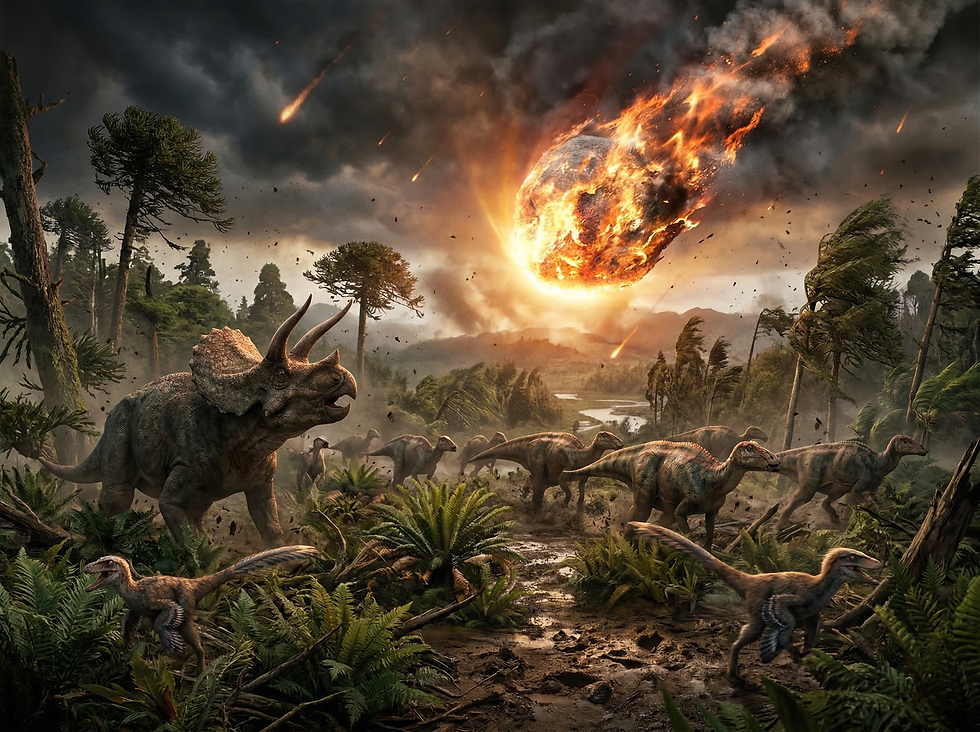
This may explain why modern culture returns again and again to impact stories, extinction stories, and global disaster films. There are hundreds of movies built around the same fear: an asteroid approaching Earth, civilization collapsing, humanity facing forces larger than itself. Again and again, we imagine endings that mirror what happened long before us. We look at dinosaurs and see not only ancient life but a warning embedded in deep time.
They were once dominant in the same way humans feel dominant now. They occupied ecosystems completely. They shaped the world around them. Yet none of that protected them from sudden catastrophe. Part of dinosaur fascination is that they force us to imagine how fragile dominance really is.
Why Children Start with Dinosaurs and Never Fully Leave Them
Children are naturally drawn to extremes, and dinosaurs offer nothing but extremes. They are often the first giant creatures children truly encounter through books, museums, toys, and films. They have horns, spikes, armor, giant teeth, impossible necks, and names that sound dramatic even before their meaning is understood.
But what makes dinosaurs important is that they also create questions. Could I outrun one? What did it eat? Why did it have armor? Why were some huge and some small? Why did they disappear? What would happen if they were alive now?
These questions matter because they pull children directly into scientific thinking. A child fascinated by dinosaurs quickly begins asking about fossils, climate, extinction, geology, biology, ecosystems, and evolution, often without realizing that they are entering scientific territory.
Dinosaurs are often the first subject that teaches a child how science works: evidence first, imagination second. That is why dinosaur fascination often becomes a doorway into broader learning.
Adults Return Because Dinosaurs Never Stop Changing
Adults rarely lose dinosaur fascination entirely. It simply changes shape. Children begin with size and danger. Adults become interested in extinction, adaptation, survival, and what dinosaurs reveal about life itself.
This is also why dinosaur stories continue to succeed so strongly in literature and film. Jurassic Park did not become iconic simply because people wanted monsters on screen. It worked because it revived something much older: the human fear of ancient power returning.
Even long before modern science fully understood dinosaurs, writers were already drawn to prehistoric life. Journey to the Center of the Earth imagined hidden worlds beneath our own because prehistoric creatures trigger wonder in ways few subjects can.
Science only strengthens that fascination. When Richard Owen named Dinosauria in 1842, he combined the Greek words deinos (terrible, powerful, fearfully great) and sauros (lizard). Even the name reflects our first reaction: awe before understanding.
Today, science has changed dinosaurs completely. Feathers replaced scales in many species. Bird ancestry changed how we think about movement. Fossilized nests changed how we think about parenting. Sound studies suggest some dinosaurs may have chirped, hissed, clicked, grunted, or produced deep resonant calls rather than simple roars. Parasaurolophus may have produced low trumpet-like sounds through its crest, while smaller theropods may have sounded closer to birds than reptiles. The more we learn, the richer they become.
Why They Still Matter
Dinosaurs remain powerful because they sit exactly where science and imagination meet. They are large enough to overwhelm us, distant enough to remain mysterious, and real enough to force us to take them seriously.
They are not simply ancient animals. They represent a lost world where power looked different, where survival followed different rules, and where even dominance could vanish without warning.
For children, dinosaurs are often the first great obsession because they make learning irresistible. For adults, they remain something deeper: proof that Earth’s history is far larger, stranger, and less secure than we often like to believe.
Perhaps that is why we keep returning to them. Dinosaurs are not only about the past. They also quietly force us to ask what kind of future waits for any species that believes its place in the world is permanent.


